
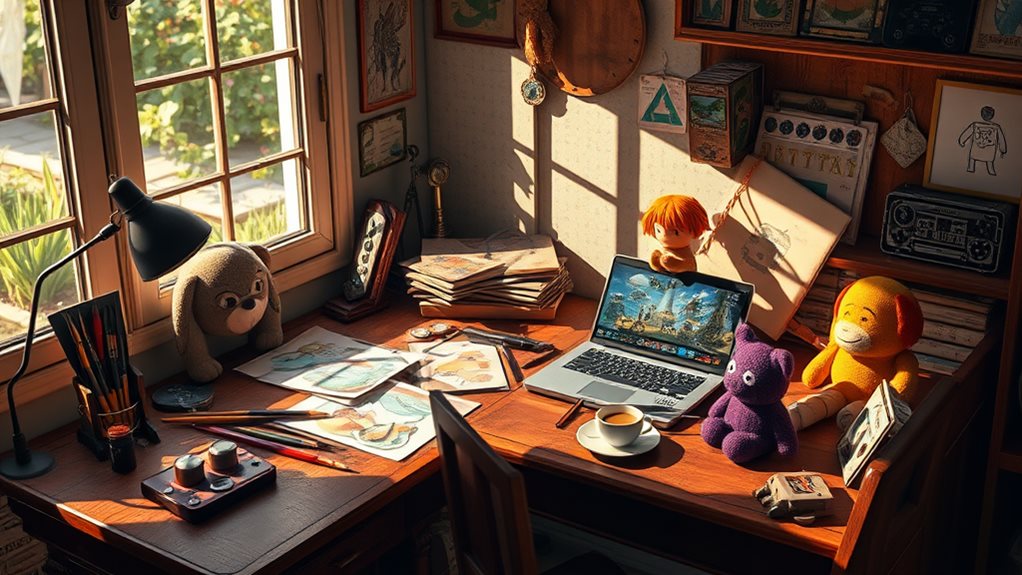
Indie games are revolutionizing creativity in the gaming world. By challenging traditional norms, they introduce unique storytelling and striking art styles that captivate players. You'll find branching narratives that let your choices shape outcomes, enriching your gaming experience. Moreover, innovative gameplay mechanics create engaging interactions that blend story and play seamlessly. These games often tap into personal themes like mental health and identity, fostering deeper emotional connections. The indie community thrives on collaboration and feedback, shaping games in real-time. If you're curious about the future landscape and opportunities they present, you're in for an intriguing journey ahead.
The Rise of Indie Games
The indie game movement has transformed the gaming landscape, pushing creative boundaries and challenging the status quo. You may have noticed how these games, often developed by small teams or solo creators, have gained significant traction.
Crowdfunding success plays a crucial role in this rise, allowing developers to secure funding directly from passionate gamers who believe in their vision. Platforms like Kickstarter and Indiegogo have empowered creators to bypass traditional publishing routes, fostering a more authentic relationship with their audience.
As you explore the indie scene, you'll see that innovative marketing strategies are equally vital. Indie developers often leverage social media, streaming platforms, and community engagement to build buzz around their projects.
They use these tools not just to promote their games but to create a sense of community that resonates with fans. By focusing on storytelling, art style, and unique gameplay mechanics, they capture attention in a crowded market.
In essence, the rise of indie games illustrates how creativity thrives when financial barriers are lowered and direct connections between developers and players are fostered.
This shift not only enriches the gaming landscape but also inspires future creators to push their own boundaries.
Unique Storytelling Approaches
In indie games, storytelling often breaks the mold, inviting players into immersive narratives that challenge traditional gaming tropes. These games leverage interactive narratives to create deeper connections, allowing you to influence the story's direction through your choices.
Unlike mainstream titles, which may rely on linear plots, indie developers often craft branching storylines that respond to your actions, making each playthrough unique. This approach fosters emotional immersion, drawing you into the character's experiences and dilemmas.
You might find yourself grappling with moral decisions, feeling the weight of your choices in ways that resonate long after the game ends. For instance, titles like "Life is Strange" exemplify how player agency can evoke genuine emotional responses, as your decisions shape the fates of beloved characters.
Moreover, indie games often explore themes that larger studios might shy away from, such as mental health, identity, or existential questions, offering a fresh perspective that resonates with diverse audiences.
This commitment to innovative storytelling not only enhances your gaming experience but also elevates the medium as a whole, showcasing how indie developers are redefining narrative in the gaming landscape.
Innovative Gameplay Mechanics
In the world of indie games, innovative gameplay mechanics often set titles apart from mainstream offerings.
You'll notice how unique control systems can redefine player interactions, while narrative-driven mechanics seamlessly blend storytelling with gameplay.
Additionally, procedural generation techniques create dynamic experiences, keeping players engaged with ever-changing environments and challenges.
Unique Control Systems
Exploring unique control systems in indie games reveals how innovative gameplay mechanics can transform player experiences.
You'll find that many indie developers experiment with motion controls and touch interactions, creating immersive gameplay that feels fresh and engaging. For instance, gesture recognition can allow you to interact with the game world in ways traditional controls can't, making gameplay feel intuitive and responsive.
Dual screen gameplay is another fascinating approach; it lets you manage resources or navigate environments seamlessly across screens. This adaptability enhances your strategic options and keeps the experience dynamic.
Additionally, adaptive input can tailor control schemes based on your preferences, ensuring that gameplay feels personalized and accessible.
Rhythm-based controls offer a unique challenge, requiring you to sync your actions with music, which deepens your engagement with the game.
Unconventional interfaces, like using a smartphone as a controller, push boundaries and invite creativity in how you interact with digital worlds.
Finally, haptic feedback enriches these experiences, providing tactile responses that make each action feel significant.
Narrative-Driven Mechanics
Narrative-driven mechanics have become a hallmark of many indie games, blending storytelling with gameplay in innovative ways. These mechanics invite you to engage deeply with the game's world, enhancing your experience through character motivations and emotional impact.
When you make choices that influence the narrative, you're not just playing; you're participating in a story that resonates on a personal level.
Take, for example, games that require you to make moral decisions. Each choice can shift the storyline dramatically, forcing you to consider your character's motivations and the consequences of your actions. This interactivity can create an emotional bond between you and the characters, making their struggles feel real and impactful. You're not merely an observer; you become an integral part of their journey.
Moreover, some indie games utilize mechanics that reflect the characters' emotional states, such as changing gameplay elements based on their mental health or relationships. This approach deepens your connection, prompting you to empathize with their challenges.
Procedural Generation Techniques
Harnessing procedural generation techniques, many indie games offer players unique and unpredictable experiences that enhance replayability and engagement. You'll find that these games utilize algorithmic complexity and randomization strategies to create immersive environments, ensuring no two playthroughs are the same.
In terms of level design, procedural generation allows for dynamic content variety, giving you diverse gameplay experiences that keep you on your toes. Whether it's exploring vast landscapes or navigating intricate dungeons, the environment generation adapts to your playstyle, making each session feel fresh and exciting.
This approach also contributes to narrative randomness, where story elements can shift based on your choices or the generated world, deepening your investment in the game.
Moreover, indie developers often focus on visual aesthetics and soundscapes generation to complement the procedural elements. The art style and audio design can dynamically adapt, enhancing immersion and player engagement.
This blend of creativity and technology not only showcases the potential of indie games but also highlights the innovative gameplay mechanics that keep players returning for more. With procedural generation, you're truly part of a living, breathing game world.
Artistic Expression in Indie Games
Creativity thrives in the realm of indie games, where developers often push the boundaries of artistic expression to craft unique experiences.
You'll notice that indie games frequently prioritize visual aesthetics, using striking art styles to create immersive worlds. From hand-drawn animations to pixel art, these visuals set the tone and mood, drawing you into the narrative in ways that mainstream titles often overlook.
Moreover, emotional resonance is a key aspect of indie games, as developers seek to forge connections between players and their stories.
Unlike larger studios, indie creators typically focus on personal narratives that reflect their experiences and values, inviting you to explore themes of love, loss, and identity. This depth allows for a more intimate gaming experience, as you engage not just with gameplay mechanics, but also with the emotional journeys of the characters.
Community and Collaboration
In the indie game scene, community and collaboration play crucial roles in shaping innovative experiences.
You'll find that platforms for collaborative game development and vibrant online communities not only foster creativity but also encourage cross-promotion among developers.
Collaborative Game Development Platforms
Collaborative game development platforms have revolutionized the way indie developers connect and create. These platforms facilitate teamwork, allowing you to brainstorm, share resources, and build games collectively, regardless of geographical barriers. You can easily find like-minded individuals who share your passion and vision, enhancing your creative process.
One of the most exciting aspects of these platforms is the ability to participate in game jams. These events challenge you to develop a game within a limited timeframe, fostering innovation and rapid prototyping. You'll collaborate closely with others, gaining new perspectives and skills while pushing the boundaries of your creativity.
Additionally, crowdfunding campaigns integrated into these platforms empower you to secure funding for your projects. By presenting your ideas to a supportive community, you can attract financial backing that enables you to bring your game vision to life. This financial support often comes with invaluable feedback from potential players who are invested in your success.
In essence, collaborative game development platforms not only enhance the creative experience but also provide the necessary tools and community support to navigate the complexities of indie game development successfully.
Online Indie Game Communities
Online indie game communities play a pivotal role in fostering collaboration and support among developers. These vibrant networks, often found in online forums and on social media platforms, create spaces where you can share ideas, seek feedback, and connect with like-minded individuals.
When you participate in these communities, you gain access to a wealth of knowledge and resources, from coding tips to art assets. Engaging in discussions on online forums allows you to tap into collective expertise, helping you troubleshoot issues and refine your game concepts.
Social media, on the other hand, offers a dynamic way to showcase your progress and attract a following. You can share your journey through posts, livestreams, or even devlogs, fostering a sense of community that encourages support and collaboration.
Moreover, these platforms often host game jams and collaborative projects, where you can team up with others to create something new and innovative. By participating, you not only enhance your skills but also contribute to a culture of creativity that defines the indie gaming scene.
Ultimately, online indie game communities empower you to push the boundaries of your creativity while building lasting connections.
Cross-Promotion Among Developers
Cross-promotion among developers has emerged as a powerful strategy within the indie gaming landscape, fostering a spirit of community and collaboration that benefits all involved.
By leveraging cross promotional strategies, developers can amplify their reach and introduce their games to new audiences. When you partner with fellow indie creators, you tap into shared resources, knowledge, and fan bases, creating a win-win situation.
These developer partnerships can take various forms, from bundling games together for a discounted price to featuring each other's titles in promotional materials. You might find success in hosting joint events or collaborative livestreams, which not only heighten visibility but also foster connections between different player communities.
Moreover, the indie scene thrives on diversity and originality, and cross-promotion allows you to showcase this rich variety. By supporting one another, you cultivate a network of trust and creativity that can lead to innovative projects down the line.
Ultimately, embracing cross promotional strategies not only enhances your game's visibility but also strengthens the indie community as a whole, proving that collaboration is key in a competitive market.
Challenges Faced by Indie Developers
Indie developers face several significant challenges that can hinder their creative processes and overall success. One of the primary hurdles is funding obstacles, which can limit your ability to hire talent and invest in marketing strategies. Without sufficient funding, you might struggle with talent acquisition, making it difficult to assemble a skilled team that can bring your vision to life.
Technical limitations also pose challenges, as developing a game requires expertise in various programming languages and tools that you or your team may not possess.
Moreover, distribution challenges arise when trying to navigate multiple platforms, each with its own restrictions and requirements. This can complicate your game's release and visibility.
On the marketing front, you need to engage your audience effectively. A well-thought-out audience engagement strategy is crucial for gaining traction, but competition analysis reveals that standing out in a saturated market is no easy feat.
If you're not careful, your unique game could get lost among countless others. By understanding and addressing these challenges, you can better position your indie game for success in an increasingly competitive landscape.
The Future of Indie Gaming
As the landscape of gaming continues to evolve, the future of indie gaming looks increasingly promising, especially with advancements in technology and distribution channels.
Emerging technologies like virtual reality, augmented reality, and cloud gaming are creating new opportunities for indie developers. These innovations allow you to craft more immersive experiences that can captivate players in ways traditional gaming couldn't.
Moreover, the rise of platforms like Steam, itch.io, and the Epic Games Store has made it easier for you to reach your audience without the need for a major publisher.
These distribution channels enable you to focus on creativity and originality, often leading to more diverse gaming experiences.
In this dynamic environment, audience engagement is crucial.
Utilizing social media and community-driven platforms, you can build a loyal following before your game even launches.
Crowdfunding has also become a viable option, allowing you to gauge interest and secure funding, which empowers you to bring your unique visions to life.
Conclusion
Indie games have transformed the gaming landscape, showcasing creativity and innovation that often outshine mainstream titles. By embracing unique storytelling, innovative mechanics, and artistic expression, indie developers carve out distinct experiences that resonate with players. While challenges persist, the collaborative spirit and strong community support drive the industry forward. As you dive into the world of indie gaming, you'll discover a vibrant tapestry of creativity that not only entertains but also inspires the future of interactive storytelling.
About The Author